
A dinosaur with feathers is not a mistake. Discover the fossil clues, why feathers do not always mean flight, and where birds fit.
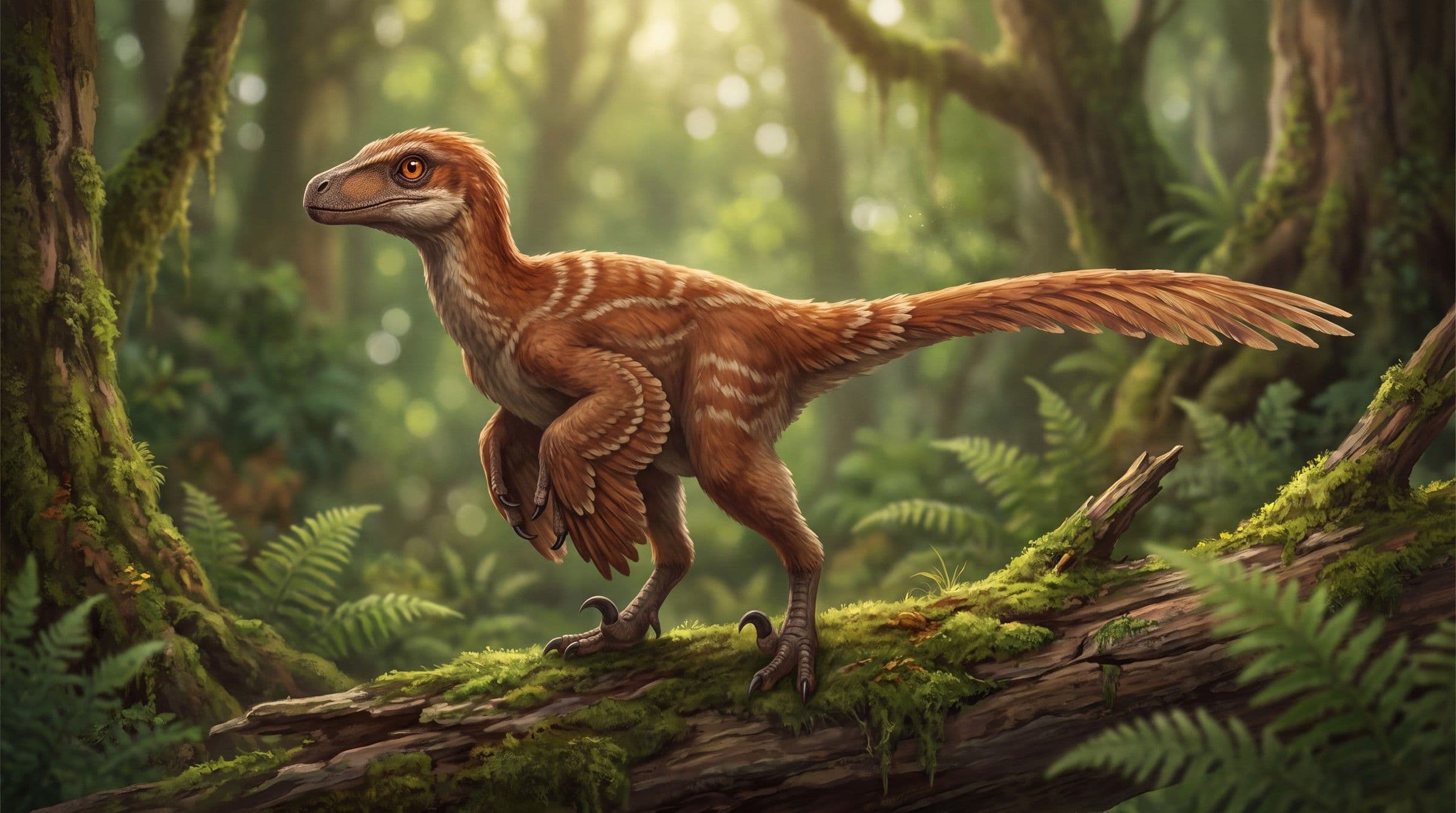
AI reconstruction · DinoFacts / Google Gemini
Give a dinosaur feathers and someone may say it looks too much like a bird. That can be exactly the point. Some of the discoveries that changed dinosaur science were not bigger teeth or longer tails. They were delicate traces of feathers—and clues on bones showing where feathers once attached.
Feathers on a dinosaur reconstruction should follow evidence, not fashion. Some exceptional fossils preserve feather impressions. In other cases, scientists examine relatives and details of the skeleton to reconstruct a likely covering.
Velociraptor provides a useful example. Researchers found small attachment bumps, called quill knobs, on an arm bone. These support the presence of long arm feathers. Related dinosaurs, including Microraptor, have been found with feathers preserved around their skeletons. The Natural History Museum explains these clues.
That is different from saying every dinosaur had the same feathery coat. Dinosaurs were a huge, varied family. Evidence about one species does not automatically describe the covering of every other species—or every part of its body.
Velociraptor had feathered arms, but it could not fly. Wings, body size and the rest of the skeleton must work together for an animal to become airborne. Adding feathers to a drawing does not supply that whole system.
Feathers can also help retain warmth. Long feathers may have been useful for display, and scientists investigate other possible roles. It is helpful to separate two questions: did this animal have feathers, and what did it use them for? A fossil may answer the first more clearly than the second.
Birds evolved within theropods, the dinosaur group that also includes T. rex and Velociraptor. They did not appear because an individual dinosaur decided to grow wings. Evolution involves changes across many generations and branching populations.
Nor did a modern bird descend from T. rex itself. Their lineages share ancestors. The museum’s bird-evolution guide describes how multiple discoveries helped scientists recognise this relationship. Birds are the surviving dinosaur branch.
Watch a bird from a distance, or study a clear photograph. Sketch the outline of its body and wings. Mark the features you can actually see. Then make a separate list of things the picture cannot tell you, such as exactly how warm its feathers keep it.
Try the same approach with a feathered dinosaur illustration. Ask which details come from fossils and which are reconstructed. A convincing image can help you imagine an animal; the evidence tells you how much confidence to place in each detail.
Explore dinosaur stories and expeditions in My Museum.
The cover is an AI illustration. Colours, soft tissues and scenery are reconstructed, not direct fossil evidence.
Discover more stories about dinosaurs, fossils and research.
Back to the guides