
Triassic, Jurassic and Cretaceous were different worlds. Build a simple timeline and discover why famous dinosaurs did not all meet.
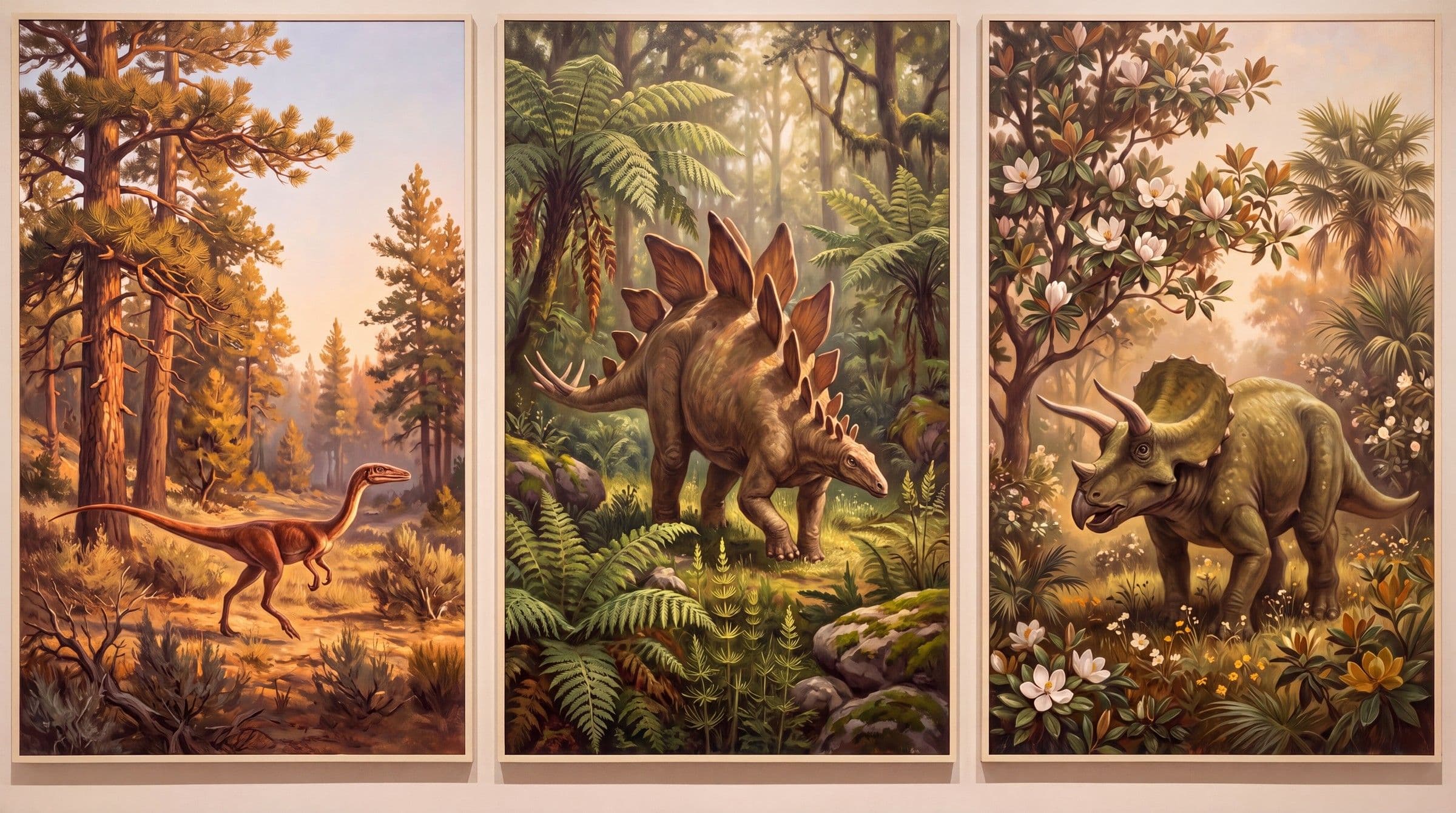
AI reconstruction · DinoFacts / Google Gemini
Imagine opening a storybook so enormous that one page could last millions of years. You would not expect every character to appear on the same page. Dinosaur history works like that: familiar names belong to different chapters, separated by enormous stretches of time.
Scientists describe these chapters as periods. The Triassic, Jurassic and Cretaceous together make up the Mesozoic Era. When a number means “million years ago”, a bigger number is further into the past. So 201 million years ago comes before 66 million years ago.
The dates below are rounded from the International Commission on Stratigraphy’s June 2026 chart. It places the Jurassic–Cretaceous boundary at about 143.1 million years ago, rounded here to 143. Older guides may show 145. Measurements improve; the order of the periods stays the same. The Natural History Museum’s overview describes their changing landscapes.
The first dinosaurs appeared during the Triassic, rather than at its very beginning. Much of Earth’s land was joined in the enormous supercontinent Pangaea. Many places were hot and dry, although this was not one identical landscape everywhere.
Coelophysis belongs near the later part of this chapter. Picture early dinosaurs sharing the world with other kinds of animals. Being a dinosaur did not automatically make an animal the biggest creature nearby.
As Pangaea broke apart, new seas and changing environments helped reshape the world. This is the chapter for famous long-necked dinosaurs such as Diplodocus and for the back plates of Stegosaurus.
“Jurassic” does not mean any time with dinosaurs. If a picture puts Stegosaurus beside T. rex, it has mixed animals from different chapters. Their names may share a toy shelf, but that is not evidence they shared a landscape.
Continents continued moving apart, and flowering plants became more widespread. T. rex and Triceratops belong near the end of this long period, not throughout all of it.
A mass extinction ended the Cretaceous about 66 million years ago. The non-bird dinosaurs disappeared, but some birds survived. Because birds are dinosaurs, the dinosaur family still has living members. The museum explains that surviving branch.
Write the three period names on cards and place them from oldest to youngest. Add Coelophysis to the Triassic, Stegosaurus to the Jurassic and T. rex to the late Cretaceous. Place a sparrow card after them, beside “today”.
Now choose another dinosaur from the site. Find its period before adding its card. Your challenge is not memorising every date. It is noticing which animals could belong to the same chapter—and remembering that even one period lasted a very long time.
Explore dinosaur stories and expeditions in My Museum.
The cover is an AI illustration. Colours, soft tissues and scenery are reconstructed, not direct fossil evidence.
Discover more stories about dinosaurs, fossils and research.
Back to the guides