
Longest, tallest and heaviest are different records. Learn how to compare dinosaur sizes without being fooled by a picture.
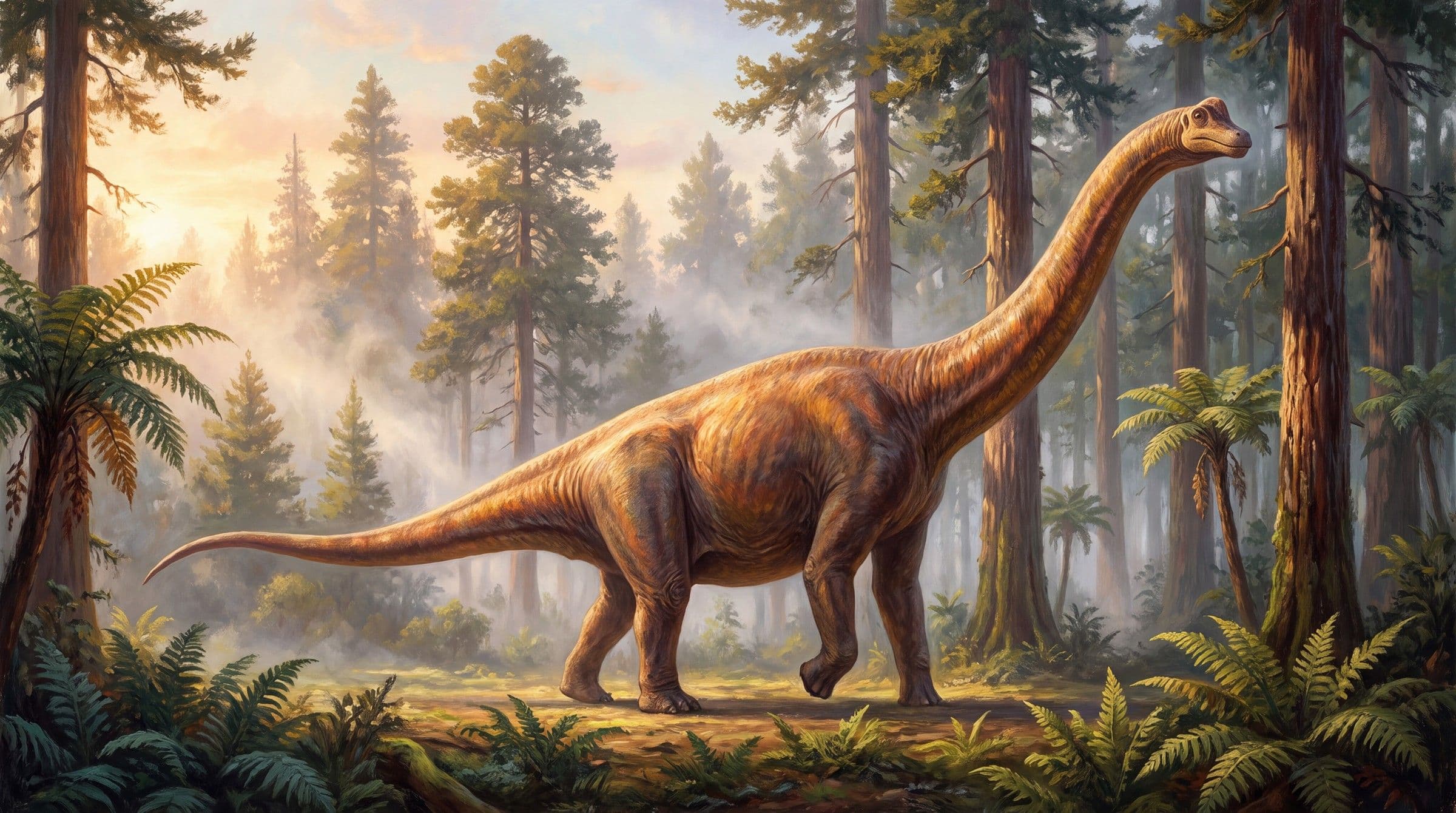
AI reconstruction · DinoFacts / Google Gemini
Imagine a dinosaur stretching past your classroom. Now imagine another standing beside your knee. Dinosaurs came in many sizes, so “How big?” needs a better question. Do you mean the longest animal, the tallest one, or the one with the greatest mass?
A brilliant dinosaur comparison begins by deciding what you want to measure.
Body length usually runs from the snout to the end of the tail. A long tail adds plenty of length without making the animal taller. Height depends on which point you measure: the hips, the shoulders or the top of the head. A raised or lowered neck can change the answer, too.
That means two dinosaurs drawn equally long can still have very different body shapes. A picture filling the same space on a card tells you almost nothing about their real sizes. Look for a shared ruler or a clear scale note.
Mass tells us how much matter an animal contains. We usually describe dinosaur mass in kilograms or tonnes. One tonne is 1,000 kilograms.
We cannot put a living Argentinosaurus on a weighing machine. Researchers estimate mass using evidence such as the thickness of limb bones or a three-dimensional reconstruction of the body. The amount of muscle, the shape of the belly and the spaces occupied by lungs all affect the calculation. Different reasonable methods can give different answers.
Giant sauropods, including titanosaurs such as Argentinosaurus and Patagotitan, are among the largest land animals known. But crowning one certain winner is difficult. Some contenders are known from only a small part of their skeleton.
Missing bones may be reconstructed by comparing relatives. That is useful, but relatives do not always have identical proportions. A new fossil or a better body model can change an estimate. A range is often more honest than a single very precise-looking number. The Natural History Museum explains how scientists estimate dinosaur size.
Choose a pretend scale: one centimetre on paper represents one metre in real life. Draw one line 10 centimetres long and another 2 centimetres long. Label them as imaginary animals measuring 10 metres and 2 metres.
The first is five times as long. Now draw a thick body around the short line and a thin body around the long one. Can the lines alone tell you their masses? No: you would need more information about their bodies.
Take that question into Dino Lab. Check the length ranges and the scale note before comparing the artwork. Then ask a scientist’s favourite follow-up: What evidence supports that size?
Compare dinosaurs to scale in Dino Lab.
The cover is an AI illustration. Colours, soft tissues and scenery are reconstructed, not direct fossil evidence.
Discover more stories about dinosaurs, fossils and research.
Back to the guides