
A tooth, a footprint and a patch of skin can answer different questions. Learn to separate a real clue from a good guess.
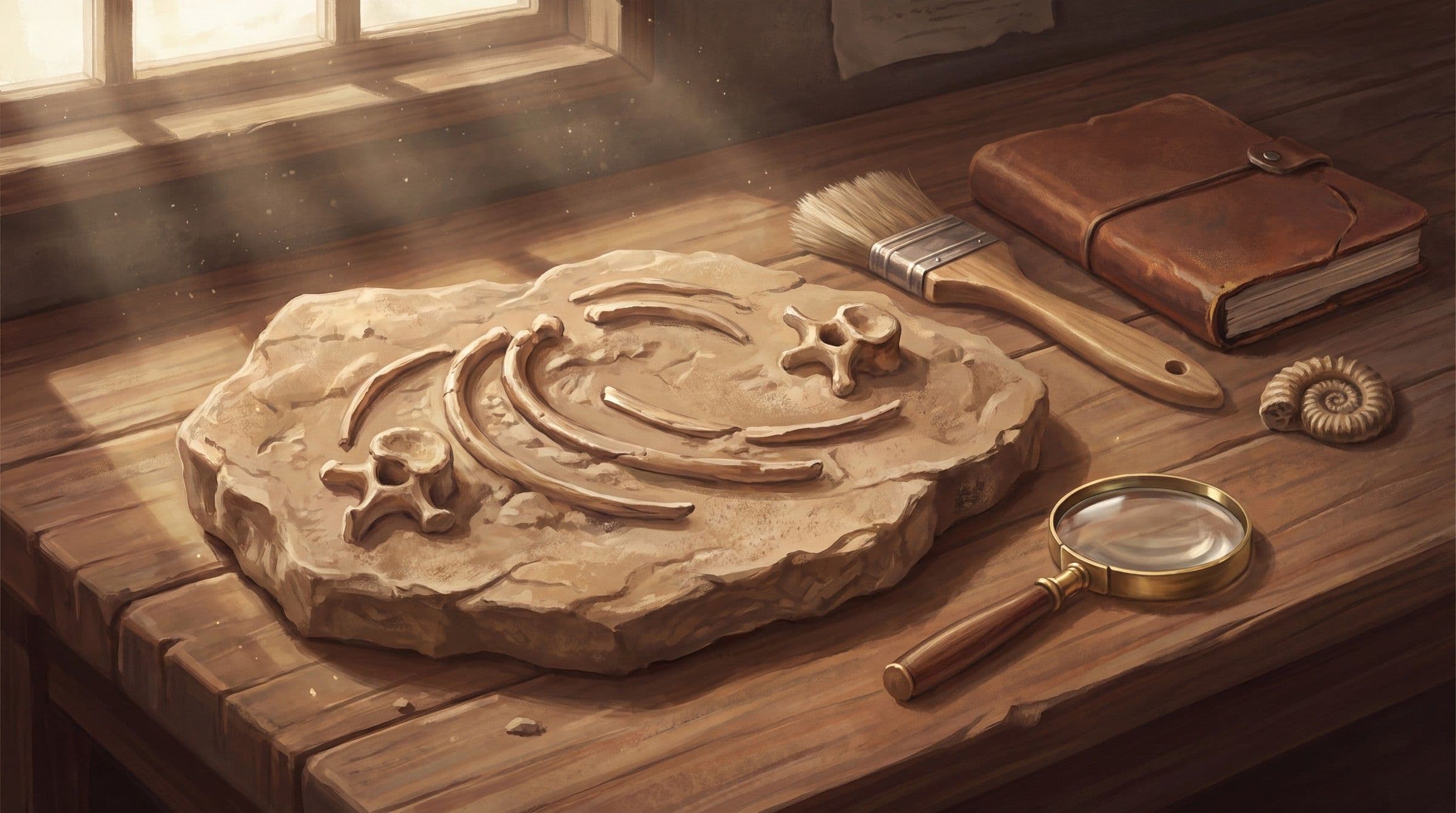
AI reconstruction · DinoFacts / Google Gemini
A footprint cannot tell you its owner’s name. A tooth cannot describe a whole day. Yet small clues can reveal remarkable things when you ask the right questions. That is the challenge facing palaeontologists: scientists who study ancient life.
Your first detective tool is a simple habit. Separate what you can see from what you think it means.
Bones and teeth are examples of body fossils: preserved evidence of an organism’s body. Footprints and fossilised droppings are trace fossils: evidence of something an animal did. Fossilised droppings are also called coprolites.
These clues answer different questions. The shape of a jaw and wear on its teeth can help researchers investigate feeding. A trackway can provide clues about footsteps and movement. Exceptionally preserved skin or feathers can tell us things that a bare skeleton cannot.
Most living things never become fossils. Their remains decay, are eaten or are scattered. Burial in mud or sand can sometimes protect remains long enough for preservation to happen. Minerals carried by water may fill spaces in bones. Other fossils form as moulds or casts.
Fossilisation is not one simple recipe, and the record is incomplete. Finding only a few bones does not mean the animal originally had only those bones. The Natural History Museum’s fossil-formation guide explains several ways evidence can survive.
Suppose you see three long marks at the end of a fossil footprint. “I can see three toe marks” is an observation. “A dinosaur made this” is an interpretation that needs comparison with other evidence.
Researchers compare fossils with other fossils and with living animals. They examine the surrounding rock and how a specimen was found. Scans can reveal structures inside a bone without breaking it open. Several independent clues supporting the same explanation make a stronger case than one exciting-looking detail.
A skeleton usually cannot tell us an animal’s exact colours or the sounds it made. A few exceptional fossils do preserve clues to colour patterns, so “we never know any colours” would also be wrong. Evidence varies from species to species.
The museum’s guide to studying dinosaurs shows how teeth, nests, tracks and modern technology contribute different pieces of the story. Reconstructions bring those pieces together, with some parts more certain than others.
Press a clean toy animal’s foot into modelling dough, then remove the toy. Ask someone to describe the mark without seeing what made it. Make two columns: “I can observe” and “My explanation”.
Compare two different toys. What extra clue would help you choose between them? You have just practised the most useful detective move: test an idea before treating it as a fact.
Put your evidence skills to work in Fossil Detective.
Discover more stories about dinosaurs, fossils and research.
Back to the guides